Wednesday, November 14, 2007

Internal Marks


Internal Marks can now be viewed in the homework folder.

Thursday, November 08, 2007

Revision questions-Short Answer

1.The Japanese occupation of much of Asia during the Second World War caused a lot of hardships amongst the civilian population. State TWO (2) ways in which the Japanese military exploited the civilian populations of their conquered countries
(4 marks)

2.Sylvia Pankhurst broke away from the Women's Social and Political Union (WSPU) in 1914. Name the organisation that she formed. (2 marks)

3.During the late 19th Century, European countries scrambled for colonies in Africa. Only TWO (2) countries in the African continent hold the distinction of remaining independent. Which two African countries hold this distinction? (4 marks)

4.The Cold War was a period of tension between the capitalist and communist ideologies.State in which conflicts did :
a)the US lose
b)the USSR lose (4 marks)

5.The city of Jerusalem is a Holy City. What is the name of the site that is holy to Christians? (2 marks)

Revision questions-Multiple choice

1.Women played vital roles during the First and Second World Wars. In which country were women allowed to enlist as soldiers fighting in the frontline?

A.Germany
B.Russia
C.England
D.Norway

2.The countries that make up the Triple Entente were:
A.Germany,Italy and Russia
B.France, Switzerland and Russia
C.Russia,England and France
D.Austria-Hungary, Germany and Italy

3.Vo Nguyen Giap and Ho Chi Minh were prominent Vietnamese nationalist figures. Name the site of the battle in which the Vietnamese forces manage to defeat the French forces and end their occupation of Indochina:
A.Ho Chi Minh City
B.Luang Prabang
C.Hue
D.Dien Bien Phu

4.Senkaku or Diayoutai Islands are a group of islands that are disputed by TWO(2) countries. Which countries claims these islands as their own?
A.Malaysia and Vietnam
B.Vietnam and China
C.China and Japan
D.Japan and South Korea

5.At the end of the Second World War, much of Europe was in ruins. The US decided that in order to stop Communism from spreading in Europe, she should give economic aid to much of Europe. This aid package was called;
A.The Truman Plan
B.The Brezhnev Plan
C.The Marshall Plan
D.The Josef Plan

Tuesday, November 06, 2007

Internal Marks


Due to unforeseen circumstances, I am unable to finish keying in your internal marks today.But don't despair-it will be in your homework folder soon.

Thursday, November 01, 2007

Tutorial-Child Soldiers


Before coming to your tutorials, it will help if you were to view the video on this Amnesty International site.

Child Soldiers-Children and armed conflict
Voices of Children at War

Monday, October 29, 2007

Spratlys


For additional information about the Spratly Islands, the southchinasea.org site should provide good reading material for your revision.

Friday, October 26, 2007

Tutorial Activity


For your tutorial class activity, please read this article.

Comfort Women

Tuesday, October 16, 2007

Notes, Notes, Notes

For notes on the Korean War, this site-Spartacus will be most helpful to all of you. The Cuban Missile Crisis? Then this site here will be useful.

The Vietnam War

Wednesday, October 10, 2007

The Middle East Notes


The Middle East is home to three of the world's greatest religions: Judaism,Chrisitianity and Islam.Sadly, the region is also wracked by what seems to be a neverending cycle of violence. Never a day goes by that we do not see images of violence and death in the Middle East on our TV screens.Why is there so much conflict, feelings of mistrust and anger amongst the Arabs and the Israelis? Finding a balanced view of the conflicts is not an easy task;most of the sites that are available on the Web are biased towards one party or the other. I have tried my best to sort out which sites are suitable for our topic, and they are listed below:

The Arab-Israeli Conflicts
Your land is my land
Suicide Terrorism-a historical background (Read this before coming to tutorial class)

Saturday, October 06, 2007

Tutorial Activity-The Vietnam War


Choose ONE photograph from this site on the Vietnam War which interests you and then complete a photo analysis sheet in class

Wednesday, September 26, 2007

Moral Studies Presentations, Sem.2


Very good effort and initiative shown by the groups so far, keep it up guys!

Wednesday, September 19, 2007

Attention!!


Starting from next week, all of you will be doing your group presentations in class ;D. Give it your best!

Friday, September 14, 2007

Individual Assignment #4: The Truman Doctrine

"At the present moment in world history nearly every nation must choose between alternative ways of life. The choice is too often not a free one. One way of life is based upon the will of the majority, and is distinguished by free institutions, representative government, free elections, guarantees of individual liberty, freedom of speech and religion, and freedom from political oppression. The second way of life is based upon the will of a minority forcibly imposed upon the majority. It relies upon terror and oppression, a controlled press and radio, fixed elections, and the suppression of personal freedoms. I believe that it must be the policy of the United States to support free peoples who are resisting attempted subjugation by armed minorities or by outside pressures. I believe that we must assist free peoples to work out their own destinies in their own way. I believe that our help should be primarily through economic stability and orderly political process."
-- President Harry S. Truman, March 12, 1947 in an Address Recommending aid to Greece and Turkey.

Questions


1. Who is Truman addressing? (2 marks)
2. What is Truman asking for? (2 marks)
3. What are the first and second "ways of life" that Truman refers to? (2 marks)
4. Who is President Truman referring to when speaking of the two different "ways of life"? (2 marks)
5. Give a modern day example of a country that lives by the first "way of life".
(2 marks)

The Cold War


The Cold War was the period of conflict, tension and competition between the United States and the Soviet Union and their respective allies from the mid-1940s to the early 1990s.

The Truman Doctrine


The Truman Doctrine was a proclamation by U.S. president Harry S. Truman on March 12, 1947. It stated that the U.S. would support Greece and Turkey with economic and military aid to prevent their falling into the Soviet sphere. The Doctrine shifted American foreign policy as regards the Soviet Union from Détente (French term, meaning a relaxing or easing) to, as George F. Kennan phrased it, a policy of containment of Soviet expansion. Historians often use it to mark the starting date of the Cold War.

More on the Truman Doctrine

Sunday, September 09, 2007

World War 2


At 4.45 am on 1 September 1939 the German battleship Schleswig-Holstein opened fire on the Polish garrison of the Westerplatte Fort, Danzig (modern-day Gdansk), in what was to become the first military engagement of World War Two. Simultaneously, 62 German divisions supported by 1,300 aircraft commenced the invasion of Poland.
Hitler's aggressive acquisition of territory began in 1936 when he ordered his army to reoccupy the Rhineland district of Germany. Bordering France, the Rhineland had been designated as a demilitarised zone by the Versailles Treaty ending World War I. It was a high-risk endeavor for Hitler. The German troops were unprepared, poorly equipped and had orders to retreat if the French offered any resistance. In the end, the maneuver went smoothly without any hindrance. Encouraged by this result, Hitler went on to absorb Austria and the German dominated Sudetenland area of Czechoslovakia into the German Third Reich in 1938. In March of the next year he occupied the remainder of Czechoslovakia...

World War Two

Individual Assignment #3:The Fight For The Mind Of Youth Starts In The Cradle


In order to consolidate their rule in Germany the Nazis made every effort to capture the loyalty of German youth. Stephen Roberts, an Australian observer of Nazi Germany, describes how this is done. Roberts was a professor of contemporary history who lived in Europe between 1935 and 1937. He traveled widely through Germany and met Hitler personally. These observations on Hitler’s Germany come from Roberts’ book, The House That Hitler Built published in 1937. Read the document and answer the questions which follow.


In order to consolidate their rule in Germany the Nazis made every effort to capture the loyalty of German youth. Stephen Roberts, an Australian observer of Nazi Germany, describes how this is done. Roberts was a professor of contemporary history who lived in Europe between 1935 and 1937. He traveled widely through Germany and met Hitler personally. These observations on Hitler’s Germany come from Roberts’ book, The House That Hitler Built published in 1937. Read the document and answer the questions which follow.

The fight for the mind of youth starts in the cradle. The baby’s earliest fairy tales must be in accordance with Nazi ideas. The Fuhrer is “the man sent from Heaven”, who triumphed over some evil people called the Allies and who started a long fight to kill the bad ogre-the Bolshevik- who is forever trying to eat up honest little German children.
At the age of ten, each little German boy gets a brown shirt…Henceforth he belongs to the “Young Folk”. The German girl will join the “Union of German Maidens”…Little boy and girl alike pledged to sacrifice everything for the Fuhrer and are taught that he is everything and themselves nothing. After four years of this, the boy of fourteen joins the Hitler Youth, the outward symbol of his promotion being the change to brown trousers and the presentation of a red swastika armband as worn by the adult members of the Brownshirt organisation…Henceforth he is a Storm Trooper in miniature…When grown up the boy goes to camp for six months,compulsory labour service…in the fields. This is followed by two years’ service in the army as a conscript, but, by the time the army gets hold of him, he is saturated by Nazi ideology…After leaving the army, our young man may become a member of the Brown or Blackshirts, first on the active list and later with the reserves…
It would be foolish to underestimate the enthusiasm of young Germany for their Fuhrer. All other interests are disappearing, and it would be misleading to think that the religious bodies …are holding their own with the children. Again and again in Germany, even in Catholic Bavaria and the Black Forest, I found cases of children whose Roman Catholic parents tried to keep them in the few struggling Church societies that still exists for children. In every case the children wanted to join the Hitler Jugend. The brown shirt or the drab blouse of Hitler won every time; the children wanted to follow the drums and fifes of their playfellows’ bands, and as they saw it, be normal. To be outside Hitler’s organisation was the worst form of punishment.
Hitler has captured the children’s heart and soul, and it is one of the adages of dictatorship that he who has control of the elementary schools for five years is established in power for ever…
Their attitude of mind is absolutely uncritical. They do not see in Hitler a statesman with good and bad points, to them he is more than a demigod. Time out of number they answered my queries why they belived or did so-and so by the reply: “Because the Fuhrer wills it!”
…The children of Germany believe that right and wrong are as distinct as black and white. Germany is always right, the rest of the world always wrong, and as for the Russians, they are literally devils from hell. It was this utter lack of any objective or critical attitude on the part of youth, even with university students, that made me fear more for the future of Germany.

Questions

1. Which organisation did boys join at the age of ten? Which organizations did girls join? (2 marks)
2. At what age did boys join the Hitler Youth? (2 marks)
3. Which organisation could young men join after they left the army? (2 marks)
4. What does Roberts describe as “one of the oldest adages of dictatorship”?
(2 marks)
5. What made Roberts “fear most for the future of Germany”? (2 marks)

Thursday, September 06, 2007

Lecture Slides

The lecture slides are available in the homework folder guys.

Sunday, September 02, 2007

Referencing

Referencing is a standardised method of acknowledging the sources of information and ideas you have used in an assignment. At the end of your essay, you need to include a list of references or bibliography of materials used in writing the assignment.

Harvard Referencing

The Armistice and the Treaty of Versailles


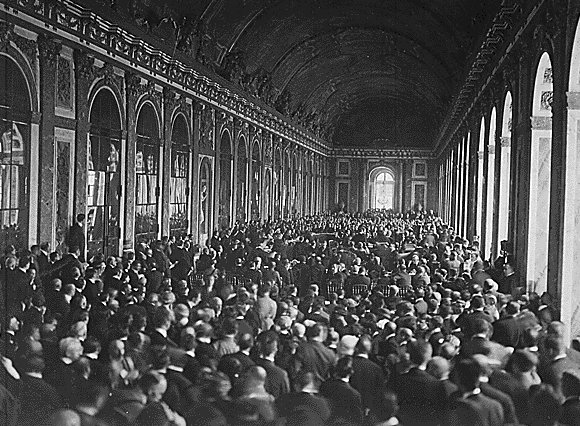
After 4 years of mindless slaughter the First World War came to an end on the 11th of November 1918 with the signing of the Armistice (An armistice is the effective end of a war, when the warring parties agree to stop fighting. It is derived from the Latin arma, meaning weapons and stitium, meaning a stopping). The Allies blamed the Germans for starting the war and they wanted revenge. Read how the Treaty of Versailles paved the way to the Second World War.

Some more info on the Treaty of Versailles