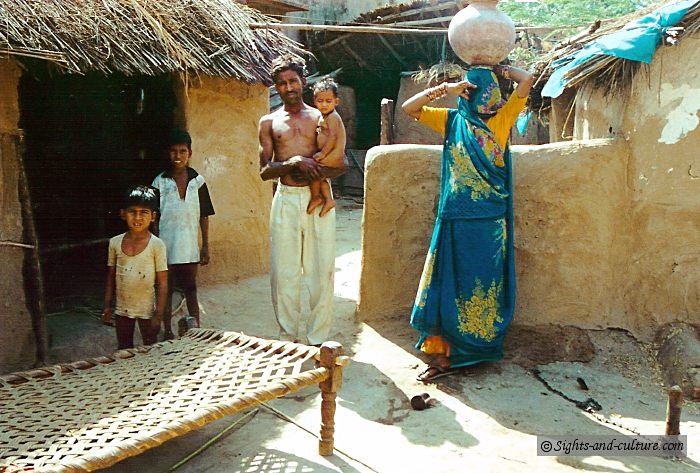
The Indian Village
In the cities in India, the rise of the middle class has changed many of the traditional ways of life. This is not necessarily true in the villages of India. The rural poor appear to live in conditions little changed from past generations. Nearly 80 percent of the Indian people still live in traditional rural villages.
Although some progress in education has been made in India, in the countryside education has been neglected. Thousands of villages remain without schools. The graduation rate from primary schools is only 37 percent, compared with more than 60 percent for all Asia.
In Indian villages, housing styles, customs and methods of farming have changed little since they were first described by Portuguese travelers in the sixteenth century. According to recent statistics, nearly 40 percent of people in rural areas live below the poverty level. The vast majority live in mud and thatch dwellings without running water or electricity, without education, often without hope. Their lives have been affected only slightly by the changes taking place in the cities or in the world beyond.
A visitor described one such village in the state of Uttar Pradesh in the upper Ganges valley:
I went inside every single cottage in the village. They are small mud huts with tiled roofs. The entrance is very low and many have no doors. Inside is a small walled in yard, lined on one side with a little verandah, and one or at the most two rooms. In each room lives a whole family. Inside the room there is usually an earthern silo for storing grain, but no other furniture. The chula (a brick or earthern stove used for cooking) is in the verandah; straw lies scattered in the yard; in some a little grain is drying on the floor. In the corner near the chula are piled neatly, face downward, the cooking utensils, earthern pots and a rare piece of brass.
That description was written in 1961, but could easily apply to thousands of Indian villages today
Questions
1.What do the majority of the rural population in India live without? (10 marks)
2.Compare your home to the home described here. How are they similar? How are they different? (10 marks)

1 comment:
sir,
can the 2nd question's answer be in the form of table? Because it is easier to see the comparison.
Post a Comment