Tuesday, March 18, 2008

Prisoner's Dilemma


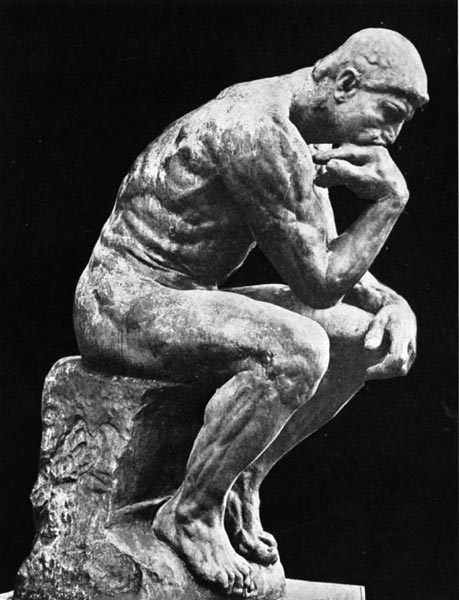
You are an inmate in a concentration camp. A sadistic guard is about to hang your son who tried to escape and wants you to pull the chair from underneath him. He says that if you don’t he will not only kill your son but some other innocent inmate as well. You don’t have any doubt that he means what he says. What should you do?

Friday, February 29, 2008

Internal Marks for Short Semester '08


Guys and gals, your internal marks are now posted in the homework folder ;D. Good luck for tomorrow's exam!

Sunday, February 24, 2008

Revision Questions

1. A relative of a patient pulls the plug on the machine that was assisting the patient to live. The relative was doing this with the full consent (permission) of the patient. This act refers to:

A) Non-voluntary euthanasia
B) Passive euthanasia
C) Active Euthanasia
D) Voluntary euthanasia

2. "Treat others, as you wish yourself to be treated". This statement best describes ONE (1) of the following theories:

A) Virtue ethics
B) Social Morality theory
C) Existentialism theory
D) Divine Command theory

3. How many concepts of value are there?

A)2
B)5
C)4
D)6

4. Mark has two very good and old friends, Peter and Paul, and he has manage to get hold of two tickets to a concert thats being sold out for weeks. Mark must make a decision on whom to pick to go with him. This strategy is called the:

A)Strategy of Compromise
B)Strategy of Dissolution
C)Strategy of Agreement
D)Strategy of Hierarchy building

5."Good and bad actions come from free choice of the individual. A good action must be voluntary, and must not be forced or compelled. It becomes bad if there is an element of force." This moral theory is called:

A)Deontology
B)Egoism
C)Utilitarianism
D)Existentialism

6.Which of the scenario listed below characterises an immoral activity?

A)A boy of three decides to draw on the wall of his house, damaging the wallpaper
B)John decided to go to school using a bus because he wanted to try travelling using the bus.
C)Steiner shot at people passing by his front lawn, causing havoc in his neighbourhood
D)Wendy is always helping out at the homeless shelter on most weekends.

More questions to come later!

Thursday, February 21, 2008


Guys and gals, sorry to inform you guys that the planned trip tomorrow is CANCELLED due to unforeseen circumstances.

Wednesday, January 30, 2008

What makes Us Moral

A good article from Time magazine on moral can be found here.

Tuesday, January 29, 2008

Be a "Simple Man"

Rock music have been maligned by certain quarters for being "immoral", but I do not agree with this view. While it is true that some musicians or singer's antics are deplorable, we cannot paint the whole rock n' roll community with the same brush.This song (originally by Lynrd Skynrd), titled "Simple Man" contains lyrics of advice as to how to live one's life by focusing on becoming a good person. Enjoy the clip ;).

Monday, January 28, 2008

Suicide Bomber


Videos from this morning's class, in case you guys want to have another look at it.

Sunday, January 27, 2008

Moral Development

Moral development concerns the development of moral values and behavior. Moral values are beliefs about what is right and wrong; moral behavior refers to actions consistent with these beliefs. Moral development is closely tied to other aspects of psychological growth. The ability to think and reason enables moral judgment, social and emotional development leads to moral values and empathy, and personality development includes the growth of conscience. Moral development is a lifelong process, especially as individuals encounter new and more complex ethical dilemmas in relations with peers, at the workplace, and in intimate relationships.

Young children acquire a sense of right and wrong partly through parental discipline but also in everyday conversations with their parents, who convey simple lessons about people’s feelings, the consequences of breaking rules, and what it takes to be a “good boy” or “good girl.” Another resource for early moral growth is the empathy that young children feel for the distress of others. For example, when parents or peers are upset, toddlers often look concerned and try to assist them. Psychologists continue to explore how interaction between parents and their young children contributes to the development of conscience and to the growth of caring for other people.

Moral development also influences the development of “prosocial” or altruistic behavior—actions such as sharing, cooperating, and helping performed for the benefit of others without expectation of a reward. Studies indicate that the motivation to act altruistically emerges very early. Young children are motivated to do the right thing primarily because they want to maintain warm relationships with caregivers and others who matter to them—not simply to avoid punishment, as was once believed.

For further readings, just visit this site

Wednesday, January 23, 2008

Heads up, class!


For next week's lectures and tutorials we will be looking at religion and ethics.Make sure that you do your readings before coming to class ;D.

Short Semester for Diploma


TELEOLOGY. Whether an action is right or wrong depends solely on the final results, regardless of how good the intentions may be. Such a person is called a teleologist.

DEONTOLOGY. Whether an action is right or wrong depends on the intention or motive behind the action, never mind the final results. Such a person is called a deontologist.

EXISTENTIALISM. Good and bad actions come from free choice of the individual. A good action must be voluntary, and must not be forced or compelled. It becomes bad if there is an element of force.

UTILITARIANISM. A good action is one that brings benefit to the majority or maximum number of people.

EGOISM. An action that has an element of self love, self preservation, or self interest.

Wednesday, November 14, 2007

Internal Marks


Internal Marks can now be viewed in the homework folder.

Thursday, November 08, 2007

Revision questions-Short Answer

1.The Japanese occupation of much of Asia during the Second World War caused a lot of hardships amongst the civilian population. State TWO (2) ways in which the Japanese military exploited the civilian populations of their conquered countries
(4 marks)

2.Sylvia Pankhurst broke away from the Women's Social and Political Union (WSPU) in 1914. Name the organisation that she formed. (2 marks)

3.During the late 19th Century, European countries scrambled for colonies in Africa. Only TWO (2) countries in the African continent hold the distinction of remaining independent. Which two African countries hold this distinction? (4 marks)

4.The Cold War was a period of tension between the capitalist and communist ideologies.State in which conflicts did :
a)the US lose
b)the USSR lose (4 marks)

5.The city of Jerusalem is a Holy City. What is the name of the site that is holy to Christians? (2 marks)

Revision questions-Multiple choice

1.Women played vital roles during the First and Second World Wars. In which country were women allowed to enlist as soldiers fighting in the frontline?

A.Germany
B.Russia
C.England
D.Norway

2.The countries that make up the Triple Entente were:
A.Germany,Italy and Russia
B.France, Switzerland and Russia
C.Russia,England and France
D.Austria-Hungary, Germany and Italy

3.Vo Nguyen Giap and Ho Chi Minh were prominent Vietnamese nationalist figures. Name the site of the battle in which the Vietnamese forces manage to defeat the French forces and end their occupation of Indochina:
A.Ho Chi Minh City
B.Luang Prabang
C.Hue
D.Dien Bien Phu

4.Senkaku or Diayoutai Islands are a group of islands that are disputed by TWO(2) countries. Which countries claims these islands as their own?
A.Malaysia and Vietnam
B.Vietnam and China
C.China and Japan
D.Japan and South Korea

5.At the end of the Second World War, much of Europe was in ruins. The US decided that in order to stop Communism from spreading in Europe, she should give economic aid to much of Europe. This aid package was called;
A.The Truman Plan
B.The Brezhnev Plan
C.The Marshall Plan
D.The Josef Plan

Tuesday, November 06, 2007

Internal Marks


Due to unforeseen circumstances, I am unable to finish keying in your internal marks today.But don't despair-it will be in your homework folder soon.

Thursday, November 01, 2007

Tutorial-Child Soldiers


Before coming to your tutorials, it will help if you were to view the video on this Amnesty International site.

Child Soldiers-Children and armed conflict
Voices of Children at War

Monday, October 29, 2007

Spratlys


For additional information about the Spratly Islands, the southchinasea.org site should provide good reading material for your revision.

Friday, October 26, 2007

Tutorial Activity


For your tutorial class activity, please read this article.

Comfort Women

Tuesday, October 16, 2007

Notes, Notes, Notes

For notes on the Korean War, this site-Spartacus will be most helpful to all of you. The Cuban Missile Crisis? Then this site here will be useful.

The Vietnam War

Wednesday, October 10, 2007

The Middle East Notes


The Middle East is home to three of the world's greatest religions: Judaism,Chrisitianity and Islam.Sadly, the region is also wracked by what seems to be a neverending cycle of violence. Never a day goes by that we do not see images of violence and death in the Middle East on our TV screens.Why is there so much conflict, feelings of mistrust and anger amongst the Arabs and the Israelis? Finding a balanced view of the conflicts is not an easy task;most of the sites that are available on the Web are biased towards one party or the other. I have tried my best to sort out which sites are suitable for our topic, and they are listed below:

The Arab-Israeli Conflicts
Your land is my land
Suicide Terrorism-a historical background (Read this before coming to tutorial class)

Saturday, October 06, 2007

Tutorial Activity-The Vietnam War


Choose ONE photograph from this site on the Vietnam War which interests you and then complete a photo analysis sheet in class

Wednesday, September 26, 2007

Moral Studies Presentations, Sem.2


Very good effort and initiative shown by the groups so far, keep it up guys!

Wednesday, September 19, 2007

Attention!!


Starting from next week, all of you will be doing your group presentations in class ;D. Give it your best!

Friday, September 14, 2007

Individual Assignment #4: The Truman Doctrine

"At the present moment in world history nearly every nation must choose between alternative ways of life. The choice is too often not a free one. One way of life is based upon the will of the majority, and is distinguished by free institutions, representative government, free elections, guarantees of individual liberty, freedom of speech and religion, and freedom from political oppression. The second way of life is based upon the will of a minority forcibly imposed upon the majority. It relies upon terror and oppression, a controlled press and radio, fixed elections, and the suppression of personal freedoms. I believe that it must be the policy of the United States to support free peoples who are resisting attempted subjugation by armed minorities or by outside pressures. I believe that we must assist free peoples to work out their own destinies in their own way. I believe that our help should be primarily through economic stability and orderly political process."
-- President Harry S. Truman, March 12, 1947 in an Address Recommending aid to Greece and Turkey.

Questions


1. Who is Truman addressing? (2 marks)
2. What is Truman asking for? (2 marks)
3. What are the first and second "ways of life" that Truman refers to? (2 marks)
4. Who is President Truman referring to when speaking of the two different "ways of life"? (2 marks)
5. Give a modern day example of a country that lives by the first "way of life".
(2 marks)

The Cold War


The Cold War was the period of conflict, tension and competition between the United States and the Soviet Union and their respective allies from the mid-1940s to the early 1990s.

The Truman Doctrine


The Truman Doctrine was a proclamation by U.S. president Harry S. Truman on March 12, 1947. It stated that the U.S. would support Greece and Turkey with economic and military aid to prevent their falling into the Soviet sphere. The Doctrine shifted American foreign policy as regards the Soviet Union from Détente (French term, meaning a relaxing or easing) to, as George F. Kennan phrased it, a policy of containment of Soviet expansion. Historians often use it to mark the starting date of the Cold War.

More on the Truman Doctrine

Sunday, September 09, 2007

World War 2


At 4.45 am on 1 September 1939 the German battleship Schleswig-Holstein opened fire on the Polish garrison of the Westerplatte Fort, Danzig (modern-day Gdansk), in what was to become the first military engagement of World War Two. Simultaneously, 62 German divisions supported by 1,300 aircraft commenced the invasion of Poland.
Hitler's aggressive acquisition of territory began in 1936 when he ordered his army to reoccupy the Rhineland district of Germany. Bordering France, the Rhineland had been designated as a demilitarised zone by the Versailles Treaty ending World War I. It was a high-risk endeavor for Hitler. The German troops were unprepared, poorly equipped and had orders to retreat if the French offered any resistance. In the end, the maneuver went smoothly without any hindrance. Encouraged by this result, Hitler went on to absorb Austria and the German dominated Sudetenland area of Czechoslovakia into the German Third Reich in 1938. In March of the next year he occupied the remainder of Czechoslovakia...

World War Two

Individual Assignment #3:The Fight For The Mind Of Youth Starts In The Cradle


In order to consolidate their rule in Germany the Nazis made every effort to capture the loyalty of German youth. Stephen Roberts, an Australian observer of Nazi Germany, describes how this is done. Roberts was a professor of contemporary history who lived in Europe between 1935 and 1937. He traveled widely through Germany and met Hitler personally. These observations on Hitler’s Germany come from Roberts’ book, The House That Hitler Built published in 1937. Read the document and answer the questions which follow.


In order to consolidate their rule in Germany the Nazis made every effort to capture the loyalty of German youth. Stephen Roberts, an Australian observer of Nazi Germany, describes how this is done. Roberts was a professor of contemporary history who lived in Europe between 1935 and 1937. He traveled widely through Germany and met Hitler personally. These observations on Hitler’s Germany come from Roberts’ book, The House That Hitler Built published in 1937. Read the document and answer the questions which follow.

The fight for the mind of youth starts in the cradle. The baby’s earliest fairy tales must be in accordance with Nazi ideas. The Fuhrer is “the man sent from Heaven”, who triumphed over some evil people called the Allies and who started a long fight to kill the bad ogre-the Bolshevik- who is forever trying to eat up honest little German children.
At the age of ten, each little German boy gets a brown shirt…Henceforth he belongs to the “Young Folk”. The German girl will join the “Union of German Maidens”…Little boy and girl alike pledged to sacrifice everything for the Fuhrer and are taught that he is everything and themselves nothing. After four years of this, the boy of fourteen joins the Hitler Youth, the outward symbol of his promotion being the change to brown trousers and the presentation of a red swastika armband as worn by the adult members of the Brownshirt organisation…Henceforth he is a Storm Trooper in miniature…When grown up the boy goes to camp for six months,compulsory labour service…in the fields. This is followed by two years’ service in the army as a conscript, but, by the time the army gets hold of him, he is saturated by Nazi ideology…After leaving the army, our young man may become a member of the Brown or Blackshirts, first on the active list and later with the reserves…
It would be foolish to underestimate the enthusiasm of young Germany for their Fuhrer. All other interests are disappearing, and it would be misleading to think that the religious bodies …are holding their own with the children. Again and again in Germany, even in Catholic Bavaria and the Black Forest, I found cases of children whose Roman Catholic parents tried to keep them in the few struggling Church societies that still exists for children. In every case the children wanted to join the Hitler Jugend. The brown shirt or the drab blouse of Hitler won every time; the children wanted to follow the drums and fifes of their playfellows’ bands, and as they saw it, be normal. To be outside Hitler’s organisation was the worst form of punishment.
Hitler has captured the children’s heart and soul, and it is one of the adages of dictatorship that he who has control of the elementary schools for five years is established in power for ever…
Their attitude of mind is absolutely uncritical. They do not see in Hitler a statesman with good and bad points, to them he is more than a demigod. Time out of number they answered my queries why they belived or did so-and so by the reply: “Because the Fuhrer wills it!”
…The children of Germany believe that right and wrong are as distinct as black and white. Germany is always right, the rest of the world always wrong, and as for the Russians, they are literally devils from hell. It was this utter lack of any objective or critical attitude on the part of youth, even with university students, that made me fear more for the future of Germany.

Questions

1. Which organisation did boys join at the age of ten? Which organizations did girls join? (2 marks)
2. At what age did boys join the Hitler Youth? (2 marks)
3. Which organisation could young men join after they left the army? (2 marks)
4. What does Roberts describe as “one of the oldest adages of dictatorship”?
(2 marks)
5. What made Roberts “fear most for the future of Germany”? (2 marks)

Thursday, September 06, 2007

Lecture Slides

The lecture slides are available in the homework folder guys.

Sunday, September 02, 2007

Referencing

Referencing is a standardised method of acknowledging the sources of information and ideas you have used in an assignment. At the end of your essay, you need to include a list of references or bibliography of materials used in writing the assignment.

Harvard Referencing

The Armistice and the Treaty of Versailles


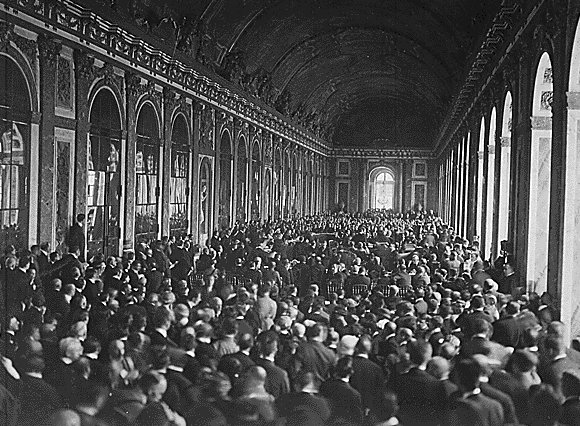
After 4 years of mindless slaughter the First World War came to an end on the 11th of November 1918 with the signing of the Armistice (An armistice is the effective end of a war, when the warring parties agree to stop fighting. It is derived from the Latin arma, meaning weapons and stitium, meaning a stopping). The Allies blamed the Germans for starting the war and they wanted revenge. Read how the Treaty of Versailles paved the way to the Second World War.

Some more info on the Treaty of Versailles

Monday, August 20, 2007

Horrors of Modern Warfare-Trench Warfare


Although there had been some trench warfare in the American Civil War of 1861 - 65, and the Russian-Japanese War of 1904 - 05, it wasn't until the First World War that fixed trench warfare became the standard form of fighting. The trench system along the Western Front ran for approximately 475 miles, in an "S" shape across Europe, from the North Sea to Switzerland.
Trench warfare created a living environment for the men which was harsh, stagnant and extremely dangerous. Not only were trenches constantly under threat of attack from shells or other weapons, but there were also many health risks that developed into large-scale problems for medical personnel. Apart from the inescapable cold during the winters in France, trenches were often completely waterlogged and muddy, and crawling with lice and rats.

Rats, Lice and corpses
Trench Warfare manual
"So you think you can do better?"- Trench Warfare game Try playing this game if you have time, folks!

Group Project, Sem.2, 2007


20th Century World History FP-030
Pre-University Studies
Group Assignment
Total Marks: 30%

INTRODUCTION
________________________________________________________________________________

"History is a guide to navigation in perilous times. History is who we are and why we are the way we are."
- DAVID C. MCCULLOUGH

The 20th Century is a very turbulent and fascinating period in human history.Each decade of the 20th century had a distinct set of issues, events, and even style. This semester, students will have the opportunity to learn more about the 20th century by examining it decade by decade.

Objectives of this project are:
§ To encourage the practice of self-directed learning and collaborative learning among students;
§ To encourage students to do research on certain topics and to help them develop skills and self-confidence in research work, either alone or in a team; and
§ To help students acquire a comprehensive and broad-ranging prerequisite background knowledge of major world events.


PROJECT COMPONENT
________________________________________________________________________________
The research component of this project will entail an action plan, in-class presentation, and report writing. This will help give you a hands-on experience and a really good understanding of a particular issue.


Action plan
_______________________________________________________________________________
You are required to select ONE issue from the decade of your choice. For this semester, you will focus on the decades beginning from the 1940s until the 1990s. Your group will have to find as much information regarding the issue.

Music
Fashion
Significant Events
Personalities


You are also expected to confirm with your lecturer on the topic by Week 4 for approval.


Group presentation (10%)
_______________________________________________________________________________
Group presentation will be conducted in Week 9 and 10. All groups will conduct their presentations in their respective tutorial classes.Duration of presentation is 15-20 minutes.

Grading will be based on:

ü The issue chosen
ü Ability to entertain questions from others
ü Creativity
ü Contents


Report writing (20%)
_______________________________________________________________________________

(A) Report (20%):
1. A research paper on your chosen topic and how it relates to today's society
2. What are the specific roles each member is assigned to?
3. Your experience when undertaking the project (inclusive of the difficulties you encounter and strengths that you acquire as a group)

Guideline for the report
Topic of the report: You can choose your own title.
Submission date: Week 10
Reference: All sources must be properly acknowledged, i.e., using Harvard referencing style.
Length: 5- 6 pages.
Font: Tahoma, Ariel, Bookman and Times New Roman. The acceptable font size is 12. This will not include any charts, graphs, or other visual depictions.
Spacing: 1.5 spaced word on white A4 paper.
Additional Reminder: Your name, ID number, program, group number, word count, tutor’s name and the title of your assignment should be on the front cover of the assignment.

Schlieffen Plan- Germany's Plan for War


Ever since Germany had inflicted defeat upon France in the Franco-Prussian War of 1870-71, the major nations of Europe had busied themselves with plans for the next war, seen by many as inevitable given the conflicting ambitions of the major powers; which, in the case of France, included the repossession of Alsace and Lorraine, both lost to Germany as a consequence of the Franco-Prussian War.

"Keep The Right flank Strong", Schleiffen's Dying Words.

Sunday, August 19, 2007

Individual Assignment #2


Gavrilo Princip describes the assassination

Gavrilo Princip was placed on trial by the Austrian-Hungarian government in October 1914. What follows is an extract from the trial’s transcript in which Princip describes the assassination. Read the document and answer the questions which follow:

The Defendant: The car approached me and I heard the detonation of the bomb. I knew that a member of our group must have thrown it, but I did not know which one. The crowd began to move, and I moved with it for a bit. The cars had stopped. I thought that all was over, and I saw how Cabrinovic was being led away. The thought flashed through my mind to kill him so the matter would be closed. But as I saw the cars start on their way again, I abandoned the idea. At that moment I could not make out the archduke. I did see a lady seated next to him, but they went by very fast and her presence made no particular impression on me. I went towards the Lateiner Bridge and heard people say that the attempt had failed. Now I asked myself where I should take up my post. I had read the itinerary in the Bosanska Posta and in the Tagblatt.
I stopped . A certain Pusara came up to me and said, “have you seen this foolishness?” I made no response. He drew me aside. I thought that he might be a police spy, and felt that he wished to make me talk. One of his parents is a spy and I figured that he was one too. I don’t know if he was still close to me when the car passed by again. I drew my gun and fired twice at (Franz) Ferdinand, at a distance of four to five feet.

Presiding Judge: The second time, did you see the lady?
Defendant: No, what I saw was that there was someone else in the car still, and I wanted to kill Potiorek.
Presiding Judge: Did you know that your shots had gone home?
Defendant: No. I did not even know how many bullets I had fired. I raised my arm to commit suicide, but policemen and officers grabbed me and beat me, in order to pay me back for what I had done. They led me away all covered with blood to the police station, where I was kicked and beaten again.

Questions

1. Whom did Princip think to kill first? (2 marks)
2. In what papers had Princip read the archduke’s itinerary? (2 marks)
3. What did Princip think Pusara was? Why? (2 marks)
4. What had Princip attempted to do after shooting the archduke and his wife?
(2 marks)
5. How was Princip treated after his arrest?
(2 marks)

Assassination at Sarajevo


The assassination of Archduke Franz Ferdinand was the catalyst for the beginning of the First World War.You can read more about the shots that started a world war by clicking on this link, here

Friday, August 10, 2007

Individual Assignment #1: Winston Churchill and The Supremacy of the British Navy


Winston Churchill became First Lord of the Admiralty in October 1911 and strongly supported the naval construction program being pursued by the government. Following the Second Moroccan Crisis Churchill gave a speech in Glasgow on the state of British naval readiness which was directed at both the British public and the Germans. Read the speech and answer the questions which follow.

“ The purposes of British naval power are essentially defensive. We have no thoughts, and we have never had any thoughts, of aggression- and we attribute no such thoughts to other great powers. There is, however, this difference between the British naval power and the naval power of the great and friendly empire-and I trust it may long remain the great and friendly empire-of Germany. The British navy is to us a necessity and from some points of view, the German navy is to them more in nature of a luxury. Our naval power involves British existence. It is existence to us; it is expansion to them. We cannot menace the peace of a single Continental hamlet, nor do we wish to do so no matter how great and supreme our navy may become. But, on the other hand, the whole fortunes of our race and empire, the whole treasure accumulated during so many centuries of sacrifice and achievement would perish and be swept utterly away if our naval supremacy were to be impaired.
It is the British navy which makes Great Britain a great power. But Germany was a great power, respected and honoured all over the world, before she had a single ship. Those facts ought clearly be stated because there is no doubt that there is a disposition in some quarters to suppose that Great Britain and Germany are on terms of equality so far as naval risks are concerned. Such a supposition is utterly untrue. The government is resolved to maintain the naval supremacy which this country enjoys…We should be the first power to welcome any retardation or slackening of naval rivalry. We should meet any such slackening not by words or deeds…If there are to be increases upon the Continent of Europe we shall have no difficulty in meeting them to the satisfaction of the country. As naval competition becomes more acute, we shall have not only to increase the number of ships we build, but the ratio which our naval strength will have to bear to other great naval powers, so that our margin of superiority will become larger and not smaller as the strain grows greater. Thus we shall make it clear that other naval powers, instead of overtaking us by additional efforts, will only be more out distanced in consequence of the measures which we ourselves will take”.


Questions.


1. What does Churchill describe the purpose of the British Navy as being?
(2 marks)
2. What does he declare to be the difference between British naval power and the naval power of Germany?
(2 marks)
3. According to Churchill what would “perish and be swept utterly away if our naval supremacy were to be impaired”?
(2 marks)
4. How would Britain meet any slacking of naval rivalry?
(2 marks)
5. What does Churchill declare will happen “as naval competition becomes more acute”?
(2 marks)

Redemption Song


For your upcoming tutorial please view the video. Have fun ;D

Monday, August 06, 2007

Colonisation

Before coming for tutorial clases make sure you guys read up on the effects of colonisation and the "Scramble for Africa".

Thursday, August 02, 2007

Mentee list for Second Semester 2007

CHIN YI TING, ROSALIE 7D7B4895
CHAN YUE YONG 7D7B5153
RACHEL KEDUNG BULAN 7D7B5204
LING YU QING, JOE 7D7B4879
LEE YEN LEE 7D7B5167
WONG KAI SENG 7D7A4872
NG SONG WU 7D7A4857
NOORANIZAH MOHAMMAD SHAKIR 7D7B5160
SITI SARAH ABDURLAHIM 7D7B4983

Welcome!!


Second Semester 2007 students, welcome to the unit! Here's to a productive semester!

Wednesday, June 13, 2007

Revision # 3


Short Answer Questions:

1.On August 2, 1964, three North Vietnamese gunboats allegedly fired torpedoes at the U.S.S. Maddox, an American destroyer in international waters. This confrontation became known as ...(2 marks)


2.The Japanese had planned the invasion of Malaya for over a year. Why was Malaya an important objective to them? (4 marks)


3. Jerusalem is an important Holy City for three of the world's greatest religions-Christianity,Judaism and Islam. State the THREE (3) important religious sites which are important to the three religions. (6 marks)

Revision # 2


1.What do the two symbols on the two hands represent? Think carefully about who the USA was fighting in the war.
2.What do you think the phrase "Keep These Hands Off!" means? Explain in your own words.
3.What would the emotional reaction to the poster be for: men? women? children?

Sunday, June 10, 2007

Revision #1


Am sorry guys, a bit late in posting this! Well, let's see how well you guys can answer these questions:

1.By what conference was Vietnam divided into North and South?
A.Vienna
B.Geneva
C.Paris
D.Prague

2.The blockade of what European city in 1948 caused an emergency airlift of supplies?
A.Paris
B.Warsaw
C.Berlin
D.London

3.The planned placement of missiles in what pro-Soviet country caused a crisis during 1962?
A.Cuba
B.Puerto Rico
C.Haiti
D.Dominican Republic

4.Where did the Allies attack in Operation Fortitude?
A.Calais, France
B.Cherbourg, France
C.Normandy, France
D.Nowhere

5.On which date did Germany invade Poland?
A.3 September 1939
B.4 December 1938
C.29 August 1939
D.1 September 1939

6.Which nation attempted a conquest of Abyssinia but was badly defeated by the Abyssinians at the Battle of Adowa in 1896?
A.Britain
B.Germany
C.France
D.Italy

7.Simultaneous attacks on major cities, towns and military bases throughout Vietnam on January 30, 1968, during a major Vietnamese holiday, was known as this Offensive:
A.Tonkin
B.Binh
C.Tet
D.Mekong

8.Where was the Peace Treaty with Germany signed in 1919 ?
A.New York
B.Versailles
C.Vienna
D.Berlin

Wednesday, May 23, 2007

Moral Studies Reports

I'll keep this simple people: for your individual reports the maximum number of pages is 5-7 pages, for your group reports its 10-12 pages. That's all troops.

Monday, May 21, 2007

Individual Assignment Marks


Yeah,yeah I know, I've been a bit late in posting the marks. They're now posted in the homework folder and I've also printed out the results and posted them on the wall outside of my office.

Sunday, May 13, 2007

Moral and History Exhibition Semester 1, 2007


It was a successful day but very tiring, don't you agree students? More pics available here, thanks lordmatthese!

Thursday, April 26, 2007

One Land, Two Peoples


Click on the above image (I know,I know no image right? Trust me just click) for an interactive lesson on why the Arabs and the Jews have been fighting over a patch of land the size of the US state of Maryland

Wednesday, April 25, 2007

Monday, April 23, 2007

The 10,000 Day War


Vietnam War, also known as the Second Indochina War, military struggle fought in Vietnam from 1959 to 1975, involving the North Vietnamese and the National Liberation Front (NLF) in conflict with United States forces and the South Vietnamese army. From 1946 until 1954, the Vietnamese had struggled for their independence from France during the First Indochina War. At the end of this war, the country was temporarily divided into North and South Vietnam. North Vietnam came under the control of Vietnamese Communists who had opposed France and who aimed for a unified Vietnam under Communist rule. The South was controlled by non-Communist Vietnamese....More

TIME magazine coverage
PBS site

14 Days In October


The Cuban Missile Crisis of October 1962 was one of the turning points of the Cold War between the United States and the Soviet Union. At that time the two superpowers came close to war, possibly with nuclear weapons; after it, both countries began to seek ways to adjust to each other, in particular, to prevent the use of nuclear weapons.. MORE

On the Brink Of Nuclear War
How the World Came Close to Armageddon

Just for recreational reading, if any of you are interested:
20 Mishaps That Might Have Started A Nuclear War

Attention!! Exhibition Dates!


The exhibition for 20th Century World History and Moral Studies will take place on the 9th and 10th of May, 2007.

Tuesday, April 17, 2007

The Cold War


Cold War, term used to describe the post-World War II struggle between the United States and its allies and the Union of Soviet Socialist Republics (USSR) and its allies. During the Cold War period, which lasted from the mid-1940s until the end of the 1980s, international politics were heavily shaped by the intense rivalry between these two great blocs of power and the political ideologies they represented: democracy and capitalism in the case of the United States and its allies, and Communism in the case of the Soviet bloc. The principal allies of the United States during the Cold War included Britain, France, West Germany, Japan, and Canada. On the Soviet side were many of the countries of Eastern Europe—including Bulgaria, Czechoslovakia, Hungary, Poland, East Germany, and Romania—and, during parts of the Cold War, Cuba and China. Countries that had no formal commitment to either bloc were known as neutrals or, within the Third World, as nonaligned nations.

Marshall Plan

Truman Doctrine

Monday, April 16, 2007

Individual Assignment #4


The Pankhursts

Emmeline Pankhurst recalled that her determination to fight for women’s rights stemmed from a childhood memory: “My father bent over me, shielding the candle flame with his big hand and I heard him say, somewhat sadly, ‘What a pity she wasn’t born a lad.’” Eventually, Pankhurst and her daughters became suffragists; they marched and fought for the right of women to vote.
The struggle was often violent. “They came in bruised, hatless, faces scratched, eyes swollen, noses bleeding,” one of the Pankhurst daughters recalled. The women were often arrested for damaging property or disturbing the peace. Once in jail, the Pankhursts, like other suffragists, went on hunger strikes. This was a potentially dangerous action. The government allowed prison authorities to force feed hunger strikers by pouring liquids into their stomachs “through a rubber tube clamped to the nose or mouth.”
Neither jail nor abusive treatment could stop the Pankhursts, however. When Emmeline, a strong willed woman with a flair for public speaking, was arrested and jailed in 1908, she informed her judges, “If you had the power to send us to prison, not for six months, but for six years, or for our lives, the Government must not think they could stop this agitation. It would go on!” It did go on, and women in Britain eventually received the right to vote.
The Pankhursts reacted to their success by taking on new causes. Emmeline became active in moral issues until her death in 1928. Her eldest daughter, Christabel, became an ardent evangelical Christian. She moved to the United States and settled in California, where she died in 1959. Sylvia, Emmeline’s second daughter, worked for social reform in London’s working class slums and became one of the founders of Britain’s Communist Party. She moved to Ethiopia to fight against the Italian invasion of that African country. At the time of her death in 1956, she was the editor of the chief English language newspaper in Ethiopia. Throughout their careers, the Pankhursts remained firmly committed to their ideals.

Questions


1.Would you be willing to go through the things the Pankhursts suffered for something you belive in? Why or why not? (10 marks)
2.Can you identify an individual, or individuals, who is fighting today for social causes against strong opposition? Would you be willing to join the fight? Why or why not? (10 marks)

Friday, April 13, 2007

History Channel presents:Tora, Tora, Tora: The True Story of Pearl Harbor

The History Channel goes in-depth with this two-volume documentary Tora, Tora, Tora: The True Story of Pearl Harbor. December 7, 1941, was a tragic and surprising day for the United States. The attack on the Hawaiian island was a costly and sudden invitation to enter World War II. Archival footage and interviews make up the bulk of this release. Both American and Japanese remembrances are included for a complete history lesson. The series begins with the events leading up to the attack, especially concentrating on Admiral Yamamoto's detailed plans. Using personal testimony, the History Channel re-creates the frantic action on the ground as American soldiers scrambled for safety. Some, such as those aboard the U.S.S. Arizona, had no time to retaliate. The program concludes with a real-life reunion of soldiers from both sides. From inception to aftermath, Tora, Tora, Tora: The True Story of Pearl Harbor provides a thorough account of a day that will always live in the memory of a nation. ~ Sarah Ing, All Movie Guide.

Individual Assignment # 3


The Indian Village

In the cities in India, the rise of the middle class has changed many of the traditional ways of life. This is not necessarily true in the villages of India. The rural poor appear to live in conditions little changed from past generations. Nearly 80 percent of the Indian people still live in traditional rural villages.
Although some progress in education has been made in India, in the countryside education has been neglected. Thousands of villages remain without schools. The graduation rate from primary schools is only 37 percent, compared with more than 60 percent for all Asia.
In Indian villages, housing styles, customs and methods of farming have changed little since they were first described by Portuguese travelers in the sixteenth century. According to recent statistics, nearly 40 percent of people in rural areas live below the poverty level. The vast majority live in mud and thatch dwellings without running water or electricity, without education, often without hope. Their lives have been affected only slightly by the changes taking place in the cities or in the world beyond.
A visitor described one such village in the state of Uttar Pradesh in the upper Ganges valley:
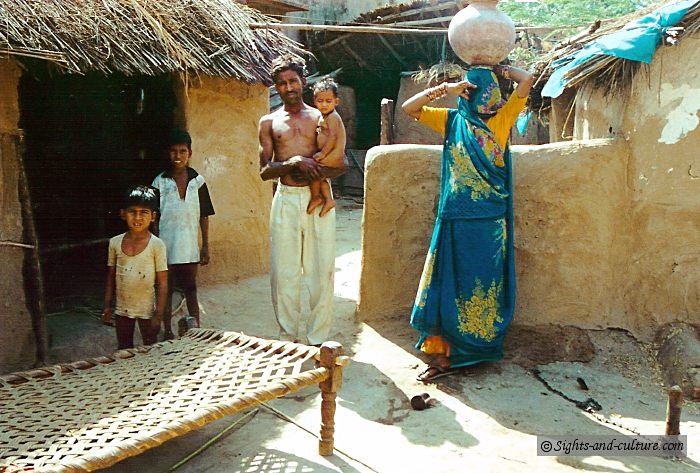
I went inside every single cottage in the village. They are small mud huts with tiled roofs. The entrance is very low and many have no doors. Inside is a small walled in yard, lined on one side with a little verandah, and one or at the most two rooms. In each room lives a whole family. Inside the room there is usually an earthern silo for storing grain, but no other furniture. The chula (a brick or earthern stove used for cooking) is in the verandah; straw lies scattered in the yard; in some a little grain is drying on the floor. In the corner near the chula are piled neatly, face downward, the cooking utensils, earthern pots and a rare piece of brass.
That description was written in 1961, but could easily apply to thousands of Indian villages today

Questions
1.What do the majority of the rural population in India live without? (10 marks)

2.Compare your home to the home described here. How are they similar? How are they different? (10 marks)

Tuesday, April 10, 2007

Attention


The written report should be handed in during Week 12 and not Week 16, my apologies for that mistake boys and girls!

Sunday, April 08, 2007

The Longest Day


The first brief communique was electrifying -- ''London, Tuesday, June 6, 1944: Under command of General Eisenhower, Allied naval forces, supported by strong air forces, began landing Allied armies this morning on the northern coast of France.'' The world caught its breath. Not since 1688 had an invading army crossed the English Channel, but now it was happening -- Operation Overlord, D-Day, the all-out attack on Hitler's fortress Europe. The first assault wave hit the beaches of Normandy at 6:30 a.m.

The place of the landing was the best-kept, most important secret of the war in Europe, and success depended on elaborate deception; but it was the individual valor of the men who went ashore in combination with the greatest marshaling of ships, planes and guns ever in history that were decisive. Never was America's productive might so dramatically employed. The armada reached as far as the eye could see.

It should never be forgotten that, of all events of our tumultuous 20th century, perhaps the most important was the defeat of the Nazi empire; and for a long and very dark time, for nearly five years, that outcome was by no means certain. D-Day was the turning point. It was day one of the final drive to complete Allied victory.

The Longest Day
So you think you're tough?
Remembrance

Now, there are societies out there that specialise in re-enactments, check out these guys:
"We Stand Alone, Together"

A recommended film to watch for all of you film buffs out there will have to be this one:

Band of Brothers

Thursday, April 05, 2007

Mentee List

1 HU KUOK FONG 7D7A4786 1
2 PETRUS LUSAT JALONG 7D7A4470 1
3 YAN AZMAN 7D7A4471 1
4 SIAW FENG 7D7A4476 1
5 XIANG RON 7D7A4484 1
6 RALPH ALEXANDER LEE 7D7A4734 1
7 RACHEL FUENTES 7D7A4745 1
8 PHEBE, LIEW SZE MIIN 7D7A4359 1
9 LIEW KIM FUNG 7D7A4474 1
10 LU HIENG JUONG 7D7A4738 1
11 SHANG KIT NYUK DOROTHY 7D7A4659 1
12 LIM CHERN WUI 7D7A4562 1
13 WEN YEE 7D7A4531 7D7A4799 1
14 LOOK MUN SAN 7D7A4799 1
15 KONG BAN HUO, BRYANG 7D7A4805 1

Tuesday, April 03, 2007

Women's Roles During The Second World War


There is little doubt that women's work in the Second World War was an important factor in the course of the war. This involvement changed the social status and working lives of women in many countries from that point onwards.

Womens' contribution to the war was significant; though the attitudes towards their contribution were typically paternalistic.

WRENS
Women Under Fire In World War Two